
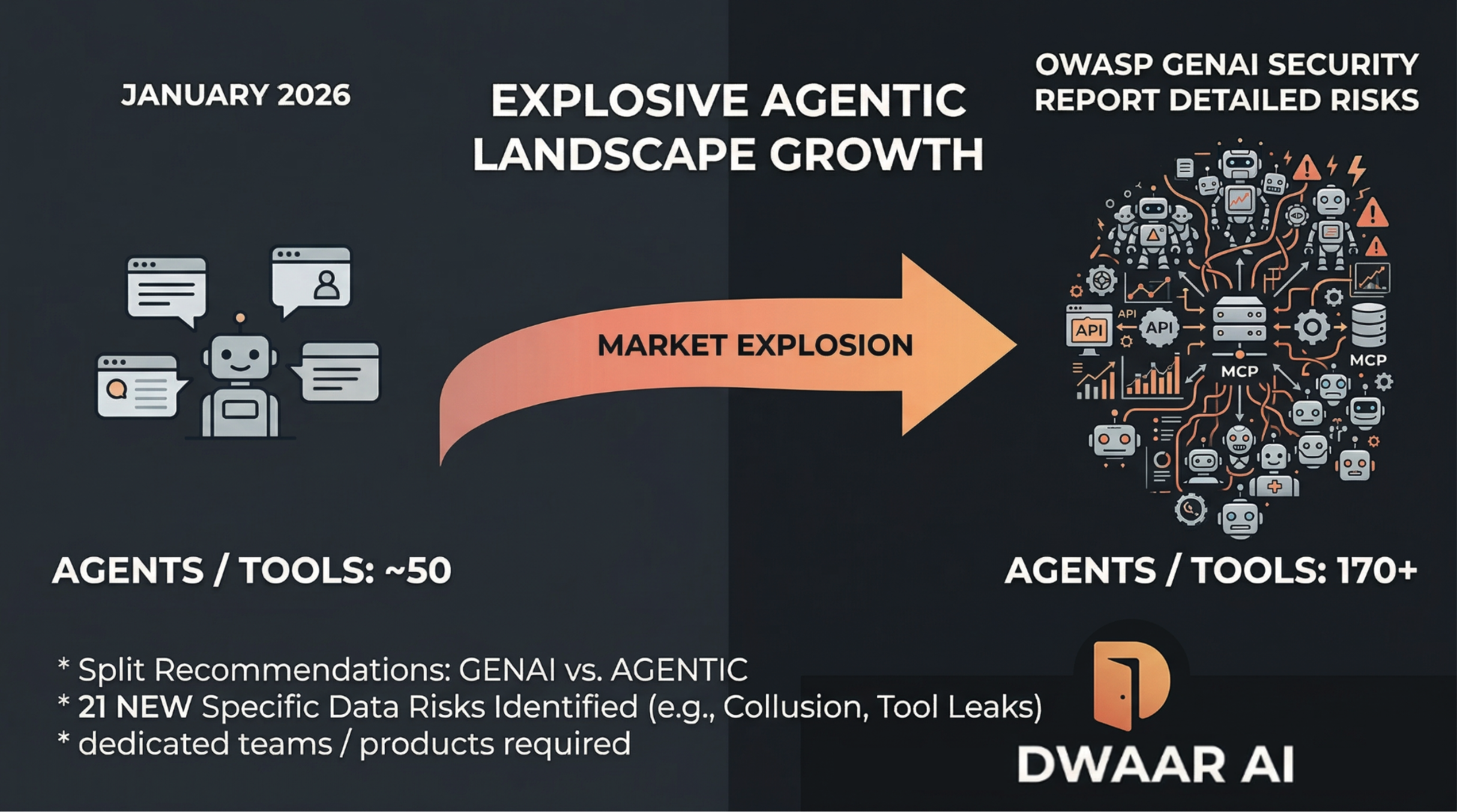
The market for securing agentic AI is moving from “emerging category” to line item. A recent MarketsandMarkets report projects the Agentic AI Security market to grow from USD 1.65 billion in 2026 to USD 13.52 billion by 2032 — a compound annual growth rate that reflects how quickly autonomous AI is entering production.
What’s driving the growth
- Agents are acting, not just answering. As organizations connect LLMs to tools, data, and other systems, the blast radius of a single failure expands dramatically.
- Traditional controls don’t fit. Signature-based and deterministic defenses were built for predictable software, not for non-deterministic, goal-seeking systems.
- Regulation and trust gaps. Security and compliance remain the top cited barriers to AI adoption, pushing buyers toward dedicated AI-security tooling.
Where the spend is going
Early budgets concentrate on three needs: visibility into where AI is being used, evaluation of AI workflows before deployment, and runtime guardrails that enforce policy as agents operate. Vendors that span build-time and run-time — rather than bolting on a single control — are best positioned as the category consolidates.
The takeaway
A market growing 8x in six years is a signal: agentic AI security is becoming foundational infrastructure, not an afterthought. Teams deploying agents should treat security as a first-class part of the stack today, not a retrofit later.
Summary based on the MarketsandMarkets report.