
On a July weekend, an autonomous attack agent broke into Hugging Face’s production infrastructure. Not through a leaked API key or a phishing email, but through a malicious dataset that abused a remote-code dataset loader and a template-injection flaw in a dataset configuration. From there it moved node to node, harvested cloud and cluster credentials, and ran tens of thousands of automated actions across a swarm of short-lived sandboxes before Hugging Face’s team caught it. Hugging Face’s own writeup is candid about the scale: internal clusters compromised, service credentials exposed, and a forensics effort large enough that the team turned to an open-weight model, GLM 5.2, because commercial provider APIs kept refusing to process the real attack payloads under their own safety filters.
No public models, datasets, or Spaces were tampered with. Hugging Face responded well: closed the execution path, rebuilt nodes, rotated credentials, tightened cluster admission, and brought in outside responders. But the incident is worth sitting with, because it is not really a story about one company’s infrastructure. It is a preview of a problem every team building on open-weight models and SLMs now has to answer.
The supply chain the industry trusts is the supply chain that got hit
Hugging Face is the distribution layer for a huge share of the open-weight ecosystem. Model weights, tokenizers, datasets, and processing pipelines pass through its infrastructure before they ever reach a training run or a production endpoint. When the nodes that touch that pipeline are compromised, the question is no longer hypothetical: what happens to every downstream system that trusted an artifact which passed through it?
This is the uncomfortable part. Most agentic applications are architected as if the model is a fixed, trustworthy component sitting behind an API call. That assumption breaks the moment the model, the weights, or the infrastructure that served them can be compromised upstream. And it does not take a full weight-poisoning attack to matter. A compromised node, a tampered checkpoint, a subtly altered fine-tune, or a model that starts behaving inconsistently under specific triggers can all look, from the application’s point of view, like “the LLM answered normally.” The application has no way to tell the difference between a model behaving correctly and a model that has been quietly altered somewhere upstream.
That is the real lesson from Hugging Face’s incident. It is not just about dataset loaders and remote code execution. It is about what your agentic application does when the thing it trusts most — the model itself — can no longer be assumed trustworthy.
Identity has to move to runtime, and it has to be about intent, not just scope
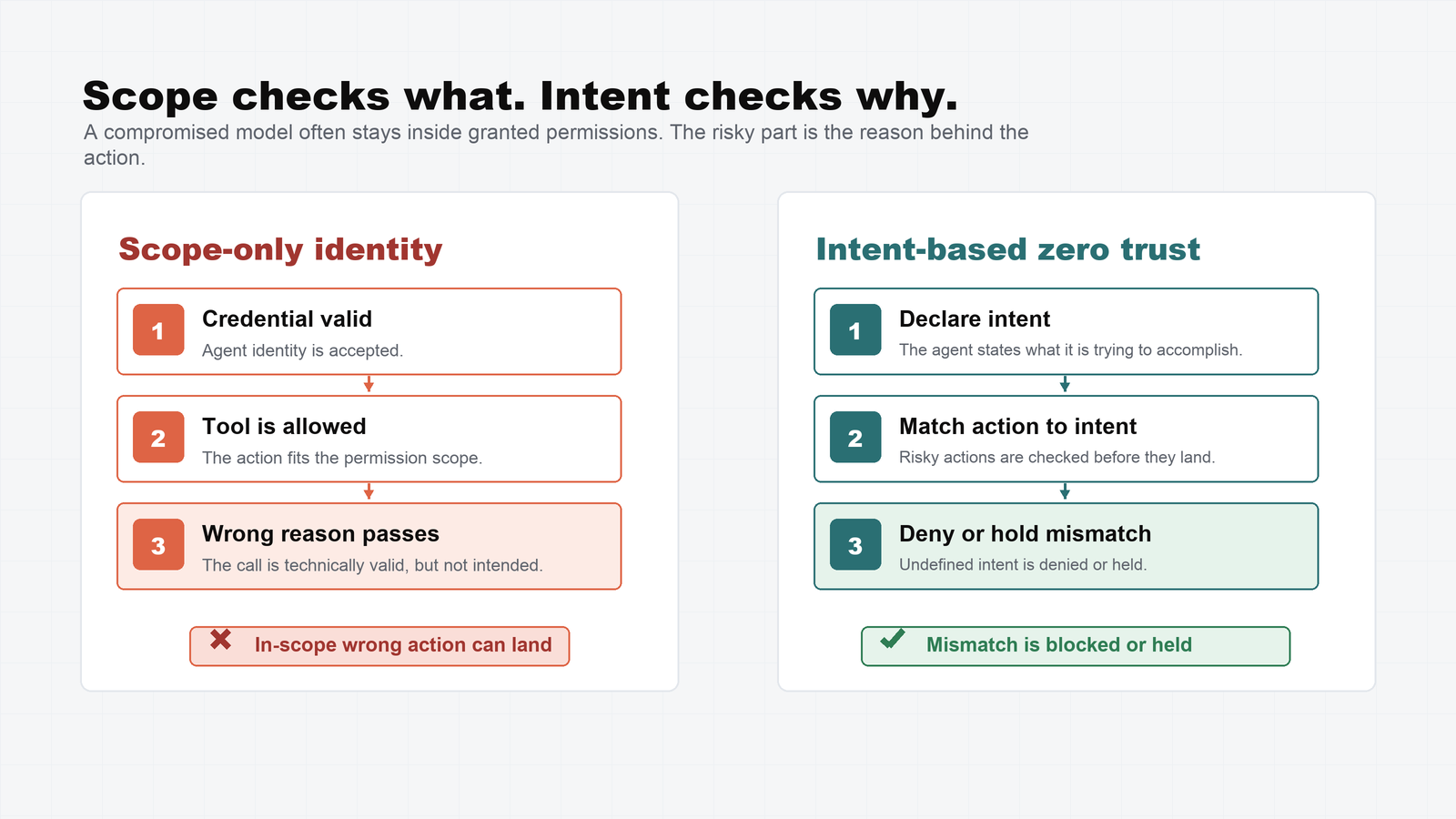
Enterprises have spent two decades building identity around users: who is logged in, what role they hold, what they are allowed to touch. The agentic identity conversation so far has mostly extended that same model one layer up — give the agent a scoped identity, a permission boundary, a “can read but not write” line. That is necessary, but the Hugging Face incident shows why it is not sufficient. Scope answers “what is this agent allowed to do.” It does not answer “why is it doing this specific thing right now.” A compromised model, or an agent whose behavior has drifted because the model behind it was tampered with, will very often stay comfortably inside its granted scope while still doing the wrong thing. The tool call is permitted. The data it touches is within bounds. The action is still wrong, because it was never actually intended.
That is the gap intent closes. Identity has to be tied to intent, not just permission: not only “is this agent allowed to call this tool,” but “was this specific action the declared purpose of this interaction.” If a model or an SLM is compromised at any stage — during training, during fine-tuning, in the weights repository, or on a compute node that served it, the way Hugging Face’s incident showed is possible — the compromise rarely announces itself as an out-of-scope action. It shows up as an in-scope action taken for the wrong reason. Scope-based identity cannot see that difference. Intent-based identity is built to catch exactly it.
The only way to make that reliable is to run it as zero trust, applied to intent rather than network location. Zero trust networking starts from “deny by default, verify explicitly.” Intent-based identity has to work the same way: if the intent behind an action is not explicitly defined and matched, treat it as the wrong intent, not as a borderline case to wave through. An agent action does not get the benefit of the doubt just because the credential is valid and the tool call is well-formed. It has to declare what it is trying to accomplish, that declared intent has to be checked against the current action, and the default outcome for an undeclared or mismatched intent is deny, not allow. That is the only posture that catches a compromised model, because a compromised model will keep presenting valid credentials and well-formed calls right up until the moment it does something it was never supposed to do.
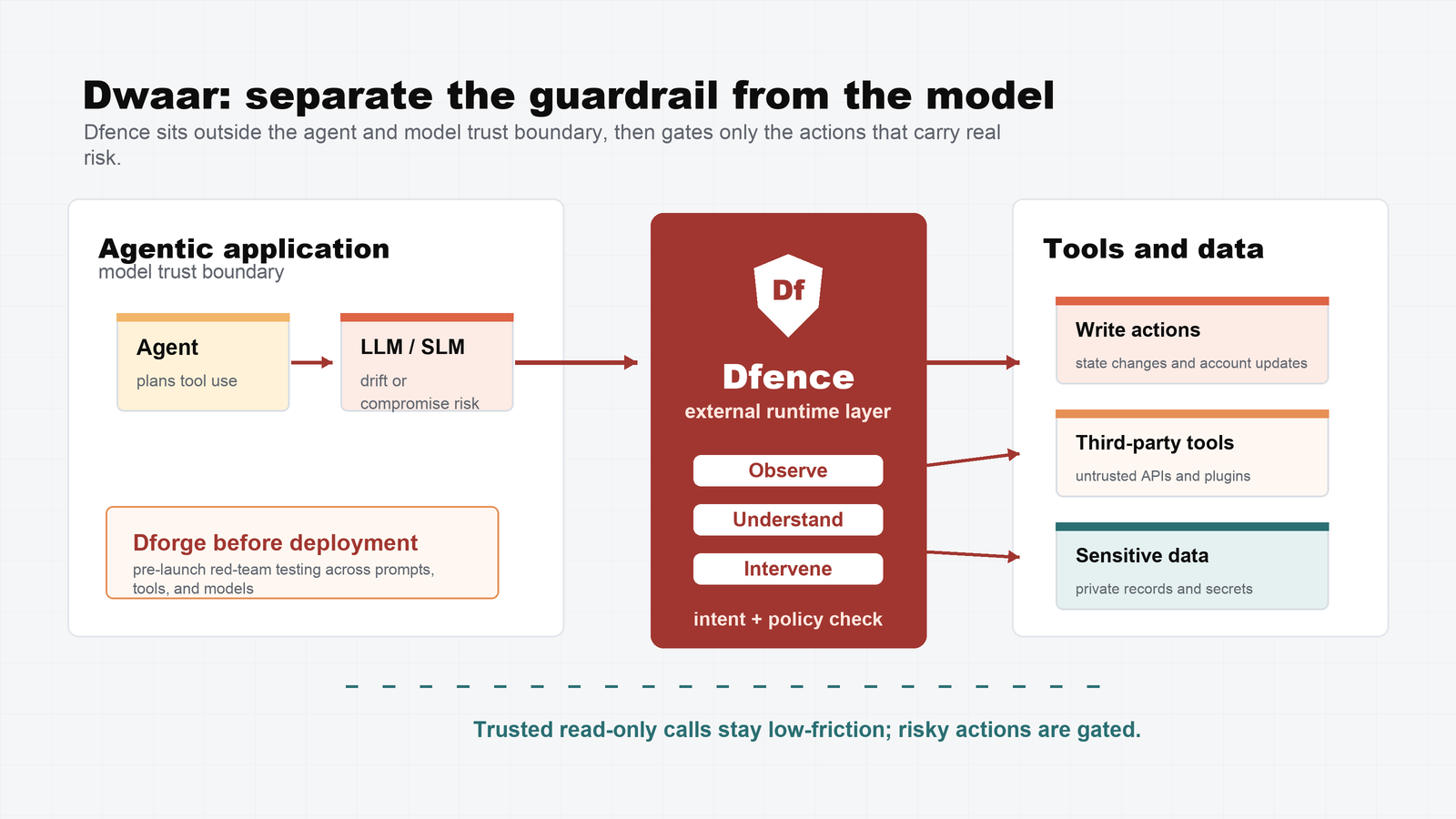
That does not mean checking intent on every single LLM interaction, and it should not. Most of what an agent does — reasoning over context it already has, drafting a response, calling a read-only, low-risk, well-trusted tool — does not need an intent check on every hop; that would add latency and noise without adding safety. Intent segregation is what makes zero trust practical instead of paralyzing: identify which interactions actually carry risk, and gate only those. A trusted, internal, low-privilege tool call in a well-understood workflow can run without friction. A write action, a call to an untrusted or third-party tool, output derived from an untrusted source such as a retrieved document or an external API response, or any action that touches sensitive data or crosses a system boundary is exactly where intent has to be explicitly checked before the action proceeds. The segregation itself is a policy decision, mapped once per tool and data source, not something re-derived on every call. That is what lets intent-based identity run at production latency instead of becoming a bottleneck nobody will actually deploy.
Guardrails cannot live inside the thing they are supposed to watch
There is a structural reason model-level safety training was not enough to stop what happened at Hugging Face, and it is the same reason model-level guardrails are not enough to stop what happens after a compromise reaches your application: a guardrail that lives inside the model, or inside the same trust boundary as the agent, fails exactly when you need it most.
If the LLM your agent is calling is compromised, subtly fine-tuned off-policy, or simply behaving erratically because of an upstream supply-chain issue, a guardrail baked into that same model or that same application process is compromised right along with it. It cannot be trusted to flag its own misbehavior. This is not a hypothetical concern. It is the direct implication of an incident where the compromise happened at the infrastructure layer that serves the model, not in a prompt a user typed.
The guardrail engine has to be physically separate from the agentic application and from the model it is watching. Separation is what makes it possible to enforce a common policy framework consistently, regardless of which LLM the agent happens to be calling this week, and regardless of whether that LLM starts behaving differently because of a bug, a bad fine-tune, or a compromised upstream node. A guardrail engine that sits outside the model’s blast radius can keep applying the same rules — block this tool, require approval for that action, stop this data from leaving — even when the model inside the loop is no longer behaving the way it was expected to.
Frontier models are not built to defend at the speed this requires
There is also a capability mismatch worth naming directly. Frontier model providers build generalist systems, and their safety filters are tuned for the general case: refuse harmful content, avoid obviously unsafe outputs, apply broad content policy. Hugging Face’s own incident report includes a small but telling detail — their forensics team had to switch to an open-weight model because commercial provider APIs kept blocking analysis of the real attack payloads, since those payloads looked like the very thing the safety filters were built to refuse.
That is not a criticism of frontier providers. It is a description of what they are optimized for. Detecting a live, evolving intrusion, or catching a subtly compromised model mid-conversation, is a narrow, adversarial, fast-moving problem. It requires specialized small models trained specifically on attack patterns, tool misuse, and policy violation, running with low enough latency to intervene before damage is done, maintained by teams whose entire job is tracking how these attacks evolve. You cannot bolt that onto a generic frontier API and call it runtime defense. It needs a dedicated SLM, a dedicated team, and a system built for exactly this job.
Where dwaar fits
This is the gap dwaar’s platform is built to close, and the Hugging Face incident is close to a textbook case for why.
dFence, dwaar’s runtime guardrail engine, is architected as a physically separate layer from the agentic application and from the LLM it protects. It does not live inside the model’s process or trust boundary, so a compromised, drifting, or misbehaving model cannot disable or evade the very system watching it. dFence enforces one common policy framework across every model an agent might call, so switching LLMs, adding a new SLM, or discovering that one model in the stack is behaving inconsistently does not mean rebuilding the security layer from scratch. It follows the same Observe, Understand, Intervene loop across every model call: watch the action, evaluate it against intent and policy, and block, redact, or require approval before the action lands, regardless of which model produced it.
That evaluation is where intent-based identity lives, and it runs zero trust. dFence does not just check whether a credential is valid or an action falls inside a granted scope. It checks whether the action’s intent is explicitly declared and matches what the agent is actually doing — and where that intent is undefined or inconsistent, the default is to deny or hold for approval, not to let it through. That is the check that catches a compromised model producing a technically-valid, in-scope, but wrong action — the failure mode Hugging Face’s incident makes concrete. And it is intent-segregated by design: low-risk, trusted, read-only tool calls run without added friction, while write actions, untrusted tool calls, and content or output derived from untrusted sources get the explicit intent check. That segregation is what keeps the runtime layer fast enough for production instead of gating every single model interaction.
dForge, dwaar’s pre-deployment layer, is where build-time detection happens. Before a model or agentic workflow goes live, dForge red-teams the full decision path — prompts, tool graph, retrieval, and the model itself — looking for exactly the kind of inconsistency an upstream compromise would introduce: a model that behaves differently than expected under specific conditions, a workflow that can be pushed off its intended trajectory, a trust boundary that assumes the model is clean when it might not be. Combined with dFence’s runtime layer, this means an organization is not relying on a single point of trust — the model vendor’s word that nothing was tampered with — but is independently verifying behavior before deployment and continuously at runtime.
And this is built by a dedicated security team, not bolted onto a generalist model. dwaar’s guardrail models are specialized SLMs trained specifically to detect policy violation, tool misuse, and behavioral drift, maintained by a team whose only job is tracking how these attacks evolve. That is the difference between a safety filter tuned for general content policy and a defense system tuned for the specific, fast-moving problem of catching an agent — or a model — that has started doing something it should not.
Hugging Face’s team did the hard work of responding well to a real breach, and their transparency about it is valuable to the whole ecosystem. But the deeper takeaway for anyone building agentic applications on open-weight models is this: you cannot assume the model you are calling is the model you think it is. You need identity checks that run at the moment of action, not just at login. You need a guardrail engine that sits outside the model it is watching, so it survives the model’s compromise instead of sharing in it. And you need that engine built and maintained by people whose job is specifically to defend at the speed attackers now operate at — not a generic safety filter borrowed from a frontier lab’s other priorities.
The model supply chain is not a solved problem. Treat it like the trust boundary it actually is.