
For decades, enterprise security has been built around a simple question: who is the user, and what are they allowed to access? Identity and Access Management has solved this well for humans. Employees authenticate, receive role-based permissions, and leave audit trails when they access applications, databases, or internal systems.
Agentic AI breaks that model.
Modern agents do not just answer questions. They plan tasks, call tools, query databases, read documents, open pull requests, send messages, and act across enterprise systems. In many deployments, an agent is no longer just a chat interface. It is an operational actor. That raises a new security question: who is the agent?
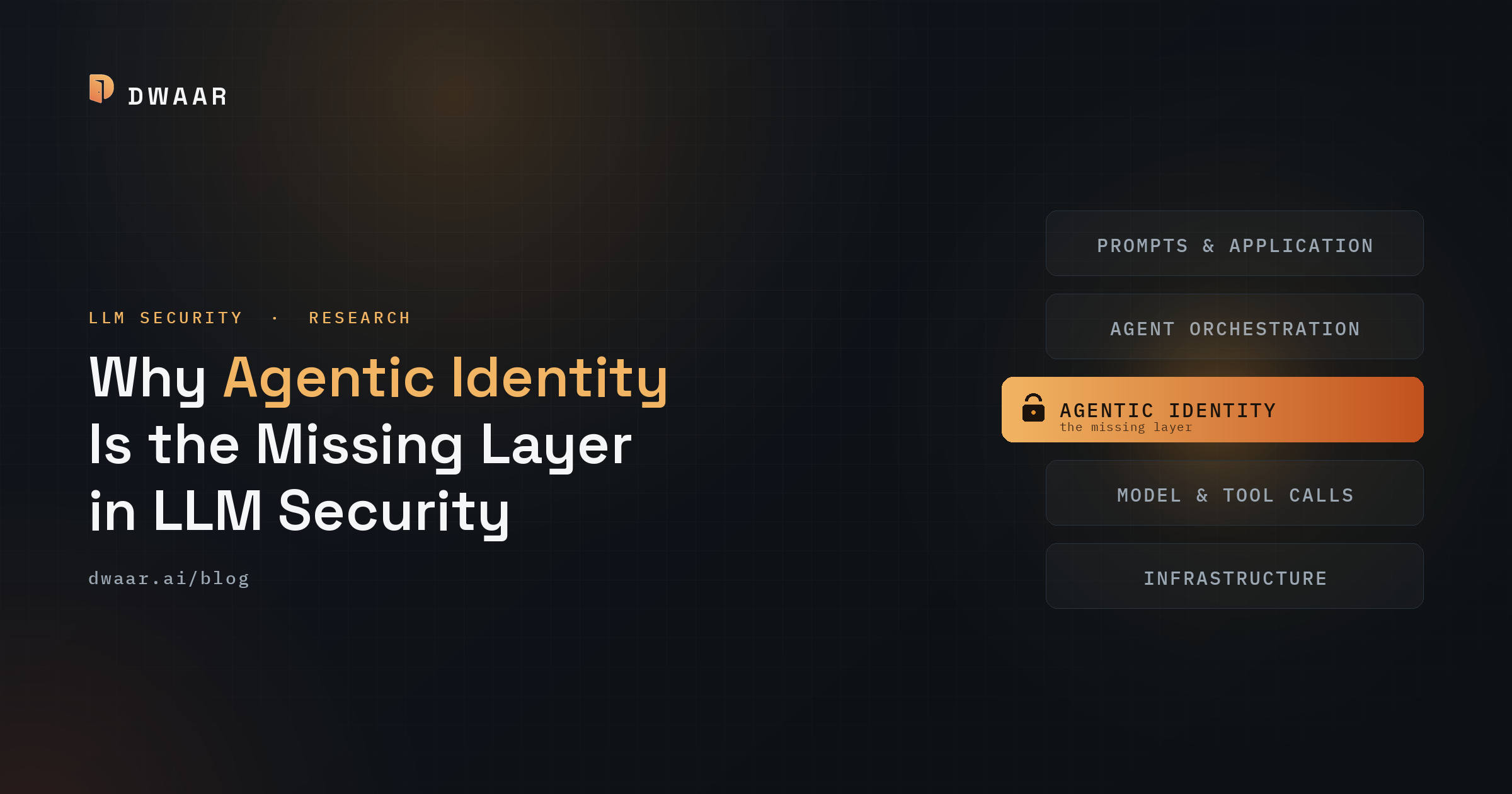
This is the missing layer in LLM security.
From IAM to Agentic Identity
Traditional IAM assumes that actions can be tied to a human user or a static service account. But autonomous agents sit between humans, tools, data, and workflows. They may act on behalf of a user, a team, a workspace, a channel, or a business process. In shared environments, the old “act as the user” model becomes fragile.
Anthropic’s June 2026 Claude Tag announcement brought this issue into sharper focus. Claude Tag introduced a model where an agent can operate with its own agent identity, scoped to a workspace or channel, with administrator-defined access to repositories, connectors, tools, standing instructions, and memories. That shift matters because access control is no longer only about what a person can do. It is also about what an agent can do in a specific context.
An agent needs a distinct, governable identity. It needs scoped credentials, clear boundaries, and audit logs that show not only who prompted it, but which tools it called, which data it accessed, and whether its actions matched its intended purpose.
Why Static Permissions Are Not Enough
The core risk is not only that an agent may have too many permissions. The deeper problem is that an agent’s behavior can change during execution.
A human identity is relatively stable. An agent’s behavior is shaped by system prompts, user instructions, retrieved documents, tool outputs, memory, and external content. A malicious email, poisoned document, compromised MCP server, or multi-turn prompt injection can redirect the agent away from its original task.
An agent asked to “summarize customer emails” may be manipulated into exporting contact lists. A coding assistant asked to “fix a bug” may be pushed into leaking repository secrets. A support agent with CRM access may be tricked into modifying customer records. In each case, the issue is not just authentication. The issue is trajectory control.
This is why OWASP’s Agentic Application Security guidance highlights risks such as Agent Goal Hijack, Tool Misuse, Identity & Privilege Abuse, Agentic Supply Chain Vulnerabilities, Memory & Context Poisoning, and Rogue Agents. These risks emerge because agents are being given real authority over tools, data, and business processes.
The Agentic Identity Crisis
Agentic identity is more than a service account. A service account answers, “Which credential was used?” Agentic identity must answer a richer set of questions:
What is this agent’s mission? Which user, team, or workflow invoked it? Which tools is it allowed to call? Which data boundaries must it respect? Can it write, delete, commit, send, or only read? Is this action consistent with the original user intent? Has the agent’s behavior drifted from its approved trajectory?
This is where many current security architectures fall short. Static IAM can decide whether a credential has access to a database. It cannot always decide whether the agent’s current reason for querying that database is legitimate.
For agentic systems, identity must become contextual, dynamic, and enforceable at runtime.
The Rise of Agentic Access Management
Agentic Access Management, or AAM, extends IAM for autonomous AI systems. It treats agents as first-class identities with their own permissions, policies, scopes, and audit trails.
In a mature AAM model, access is not granted once and forgotten. It is continuously evaluated. The agent’s task, tools, data sources, prompts, retrieved context, and outputs are monitored together. A safe request remains safe only while the agent stays within its intended purpose.
This also changes how enterprises should think about least privilege. Least privilege for agents cannot be limited to “read-only” or “write-enabled.” It must include task-level boundaries. For example, an agent may be allowed to read invoices for bill comparison, but not export all customer billing history. It may be allowed to open a pull request, but not merge to production.
The unit of control becomes not just the user or the API, but the agentic action path.
dFence: Runtime Protection for Agentic Identity
To address this gap, dwaar has introduced dFence, a self-healing security platform designed for agentic applications. dFence focuses on protecting agents at runtime, where static guardrails and pre-deployment testing are no longer enough.
The platform follows a continuous lifecycle: Observe, Understand, and Intervene.
Observe means monitoring live agent behavior across prompts, tool calls, retrieval systems, MCP servers, APIs, and workflows.
Understand means evaluating whether the agent’s behavior is consistent with policy, context, and intent. This requires more than keyword filtering. dFence combines deterministic rules with contextual AI-based judgment to detect risky trajectories, privilege misuse, tool abuse, data exposure, and policy drift.
Intervene is the self-healing layer. When an agent begins moving off-policy, dFence does not merely generate an alert. It guides the application to take corrective action in real time. That may mean blocking a tool call, redacting sensitive output, forcing human approval, narrowing the agent’s scope, or stopping a workflow before damage occurs.
This matters especially in MCP and tool-rich environments, where the attack surface is the full graph of prompts, tools, credentials, retrieval systems, memory, and downstream actions.
As agents become the primary interface to enterprise systems, identity will no longer belong only to humans. Every agent will need a name, a purpose, a scope, a permission boundary, and a live security layer watching whether it remains trustworthy.
The next generation of IAM will not ask only, “Who is the user?”
It will ask, “Who is your agent, what is it trying to do, and should it be allowed to continue?”